
How to ship inventory from Turkey to Amazon FBA by sea

To ship to Amazon FBA from Turkey by sea, book LCL (less-than-container-load) ocean freight to a U.S. port, clear customs with a U.S. importer of record, a bond and an ISF filing, then truck palletized, FNSKU-labeled cartons to the fulfillment centers in your Send to Amazon plan. ExperShip runs weekly LCL departures from Turkey with cargo insurance included.
Key takeaways
- Amazon does not import for you. You (or a customs broker acting for you) must be the U.S. importer of record, hold a customs bond and file the ISF before the cargo is loaded in Turkey.
- LCL lets you ship a few pallets instead of a full container. ExperShip's Turkey to U.S. lane has weekly departures and includes cargo insurance on every LCL shipment.
- Most FBA problems start before the boat leaves: wrong carton labels, oversized pallets, or no delivery appointment. Fix those at the packing stage.
- Plan on roughly 25 to 35 days door-to-door for the ocean leg and delivery, then add Amazon's check-in time.
What are the steps to ship from Turkey to Amazon FBA by sea?
The sequence matters because some deadlines (the ISF, the Amazon shipment plan) sit upstream of the vessel. Here is the order that works in practice.
- Set up your U.S. import identity. Decide who is the importer of record (IOR, the party legally responsible for the goods, duties and filings). A non-resident business can use a CBP-assigned importer number (CBP Form 5106), and most sellers use a licensed customs broker to handle this. See our guide to importer of record and customs bond requirements.
- Classify the product. Find the 10-digit HTS code (Harmonized Tariff Schedule number) for each SKU. It drives the duty rate. Get it wrong and the entry can be held or re-rated.
- Build the Send to Amazon plan. In Seller Central, create the inbound plan, choose cartons or pallets, and print FNSKU labels (Amazon's item-level barcode). Amazon assigns the destination fulfillment centers, and one plan can be split across several.
- Pack to Amazon's carton and pallet rules. Details are in the prep section below.
- Book LCL freight. Share cargo volume (cubic meters), weight, pickup address in Turkey and the Amazon destination addresses. Request an LCL freight quote and ask that FBA delivery be included.
- Complete the Turkish export declaration and deliver to the consolidation warehouse. The cargo goes to the freight station (CFS, container freight station) before the weekly cutoff, where it is consolidated into a shared container.
- File the ISF. Importer Security Filing ("10+2") data must reach CBP at least 24 hours before the cargo is loaded onto the vessel in Turkey. CBP can assess penalties of up to $5,000 per violation for late or inaccurate filings (CBP: Importer Security Filing).
- Sail, arrive, clear customs. At the U.S. port the container is devanned (unloaded), your freight is released after entry is filed and duties are paid, and it is trucked on.
- Deliver to FBA on an appointment. Pallet freight needs a delivery appointment at the fulfillment center. The carrier books it, and you track check-in in Seller Central.
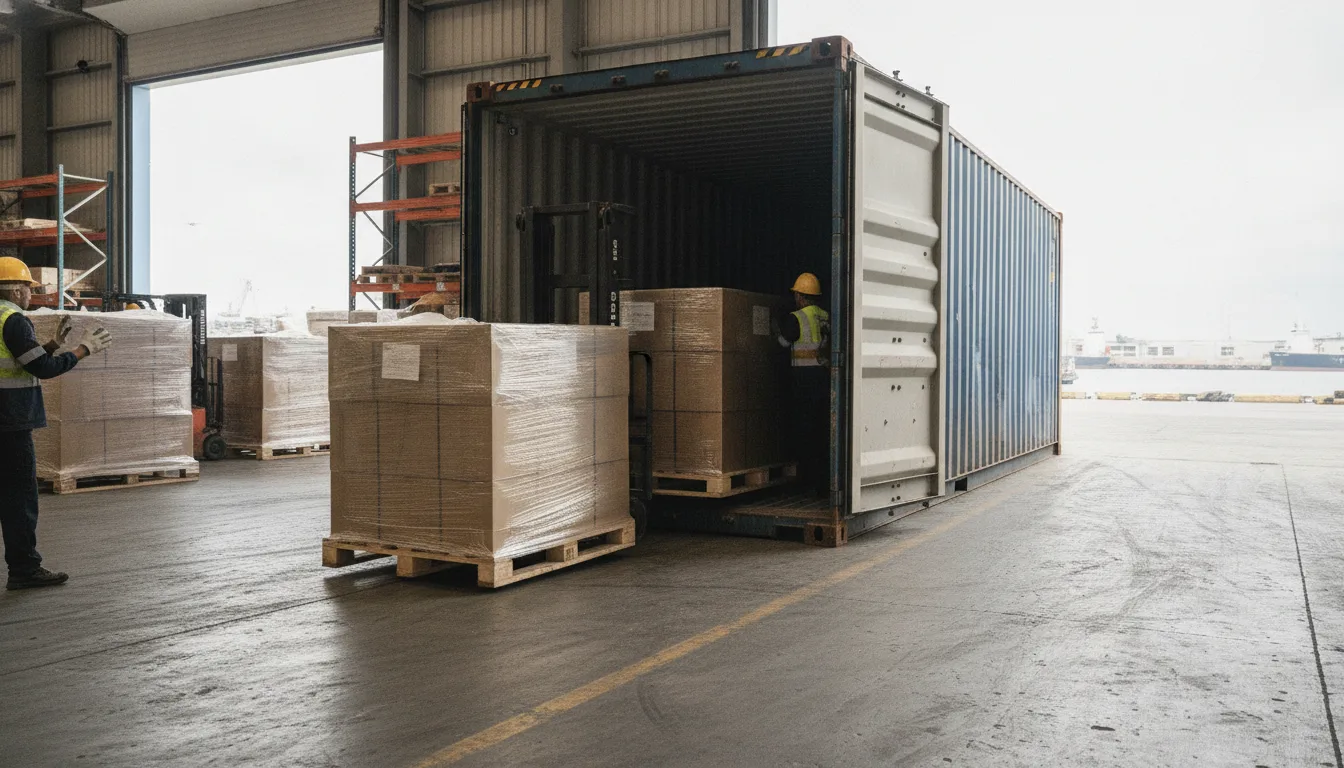
Why use sea freight instead of parcel for FBA inventory?
Parcel works for samples and small replenishment. For inventory in bulk, sea freight usually wins on cost per unit, and since the U.S. suspended de minimis duty-free entry on August 29, 2025 (made indefinite by CBP in June 2026), low-value parcels no longer enter duty-free either. Every route pays duty, so the choice comes down to freight cost and speed. Our de minimis suspension explainer covers what changed.
| Factor | Express parcel | LCL ocean freight |
|---|---|---|
| Best for | Small, urgent, low-volume | Several pallets or 1 to roughly 15 cubic meters |
| Cost driver | Billable weight (actual or dimensional) | Cubic meter or weight, whichever is greater (1 CBM is treated as 1,000 kg) |
| Transit | Days | Weeks (about 25 to 35 days door-to-door on ExperShip's Turkey lane) |
| Customs | Carrier handles entry, duty billed to you or recipient | You need an IOR, bond and ISF |
| Amazon fit | Cartons by small-parcel inbound | Pallets by LTL/FTL freight with appointment |
For a deeper look at the trade-off, read LCL ocean freight explained and shipping from Turkey to the USA: parcel or LCL.
How do customs, the bond and the ISF work for FBA shipments?
Amazon's fulfillment centers are not ports of entry. Before your goods can move inland, someone must file a customs entry and pay duties. That someone is the importer of record, which Amazon is not.
What does the customs bond do?
A customs bond is a guarantee to CBP that duties and fines will be paid. A single-entry bond covers one shipment. A continuous bond covers a year of entries and typically makes sense if you ship more than a few times annually. An ISF also requires a bond. Your broker normally arranges it.
Informal or formal entry?
Commercial shipments valued above $2,500 generally need a formal entry, and many other goods require it regardless of value. Inventory pallets almost always land in formal entry. Compare the two in U.S. customs entry types.
What will I pay at the border?
Expect these line items on top of freight:
- Duty: the HTS rate for your product and country of origin, plus any additional tariff measures in force when you enter. Confirm the current rate with your broker, because tariff rules have changed repeatedly.
- Merchandise Processing Fee (MPF): a percentage of value, with a minimum and maximum that CBP adjusts each fiscal year.
- Harbor Maintenance Fee (HMF): 0.125% of value on ocean shipments.
- Broker, bond and ISF fees, plus destination charges at the port and freight station.
For a quick estimate, try the import duty calculator, then verify with a broker before you commit to a landed price.
How should I prepare cartons and pallets for Amazon?
Amazon's requirements change, so check Seller Central before every inbound. These are the limits sellers hit most often (see Fulfillment by Amazon for the official program and current help pages).
- Carton weight: keep each box at 50 lb (22.7 kg) or less. Heavier boxes need team-lift labeling, and very heavy ones are rejected.
- Pallets: use a standard 48 x 40 inch pallet, stacked no higher than 72 inches including the pallet, and no more than about 1,500 lb. Shrink-wrap, no overhang.
- Labels: every unit carries a scannable FNSKU (or is covered by manufacturer barcode setup if you use it), every carton a shipment box ID label, every pallet a pallet ID label on each side.
- Country of origin: imported goods must be marked with their country of origin (for example "Made in Turkey"). Textiles and some other categories also have fiber or content labeling rules.
- Carton content: one SKU per carton is easiest. Mixed cartons need accurate box content information or you risk receiving fees and delays.
Ask your Turkish supplier or packer to do FBA prep before the goods leave. Fixing labels in a U.S. warehouse costs more and can add days.
How long does it take, from Turkish warehouse to FBA shelf?
| Stage | Typical time | Notes |
|---|---|---|
| Packing, labeling, pickup in Turkey | 3 to 7 days | Depends on your supplier; start here to protect the weekly cutoff |
| Ocean leg, customs and trucking to FBA | About 25 to 35 days door-to-door | Stated for the ExperShip Turkey to U.S. LCL lane; weekly departures |
| Amazon appointment and check-in | Days to a few weeks | Longest at peak season; units are not sellable until received |
Working backward: if you need stock live before Q4, book freight in late summer, not in October. A missed weekly cutoff costs a full week.
What goes wrong most often?
- Late ISF. The filing deadline is tied to loading, not arrival. Send commercial invoice and packing list details to your broker early.
- Wrong HTS code or value. Undervaluation and misclassification trigger holds and penalties. Declare the real transaction value.
- No delivery appointment. Pallet loads that arrive without one can be turned away and rebooked at your cost.
- Split destinations. Amazon may send a plan to several fulfillment centers. Each destination is a separate delivery and may be priced separately.
- Restricted or prohibited items. Some categories (certain supplements, batteries, cosmetics, food) need extra documents or approval from Amazon or U.S. agencies like the FDA.
Where does ExperShip fit?
ExperShip runs LCL ocean freight from Turkey to the U.S. with weekly container departures, and cargo insurance is included on every LCL freight shipment. It can deliver to Amazon FBA. Read the Turkey to U.S. LCL freight service and the LCL freight FAQ, then use the freight quote form to confirm pallet counts, destinations and who handles each filing for your shipment. This lane is Turkey only. We do not run LCL freight from any other origin.
Once inventory is in the U.S., you will probably also fulfill orders from your own site or other channels. ExperShip's multi-carrier shipping software buys, prints, tracks and automates labels for those domestic orders. Starter is $9.99 per month for 500 labels (UPS, FedEx and USPS). Growth is $49.99 per month for 5,000 labels, adding DHL, regional carriers, rate shopping, automation rules, the API and 5% off shipping rates. Paying annually saves 17%. Billing is a prepaid USD balance, and there is no free plan. For the big picture on importing, start with our cross-border ecommerce shipping guide.
Frequently asked questions
Can I send inventory directly from Turkey to an Amazon fulfillment center?
Yes, but only after the goods clear U.S. customs. Amazon does not act as your importer, so you need an importer of record, a bond and an ISF, and then the freight is delivered to the fulfillment centers in your inbound plan.
How long does sea freight from Turkey to FBA take?
On ExperShip's LCL lane, plan on about 25 to 35 days door-to-door, with weekly departures. Add a few days to a few weeks for Amazon check-in before units become sellable.
Do I need a customs bond to ship to Amazon FBA?
In practice, yes. An ISF requires a bond, and formal entries for commercial inventory do too. A single-entry bond works for a one-off shipment, while a continuous bond suits repeat shippers.
Is LCL or FCL better for FBA replenishment?
LCL usually wins for a few pallets up to roughly 10 to 15 cubic meters, because you pay only for the space you use. Above that, compare against a full container (FCL) quote.
Is my cargo insured on the way to Amazon?
Cargo insurance is included on every ExperShip LCL freight shipment. Confirm coverage terms on your quote, since insurance on parcel labels is a separate matter and not live.
Ready to get your Turkey inventory moving and your U.S. orders labeled? Start your 30-day free trial of ExperShip (Starter or Growth, no card needed to sign up).